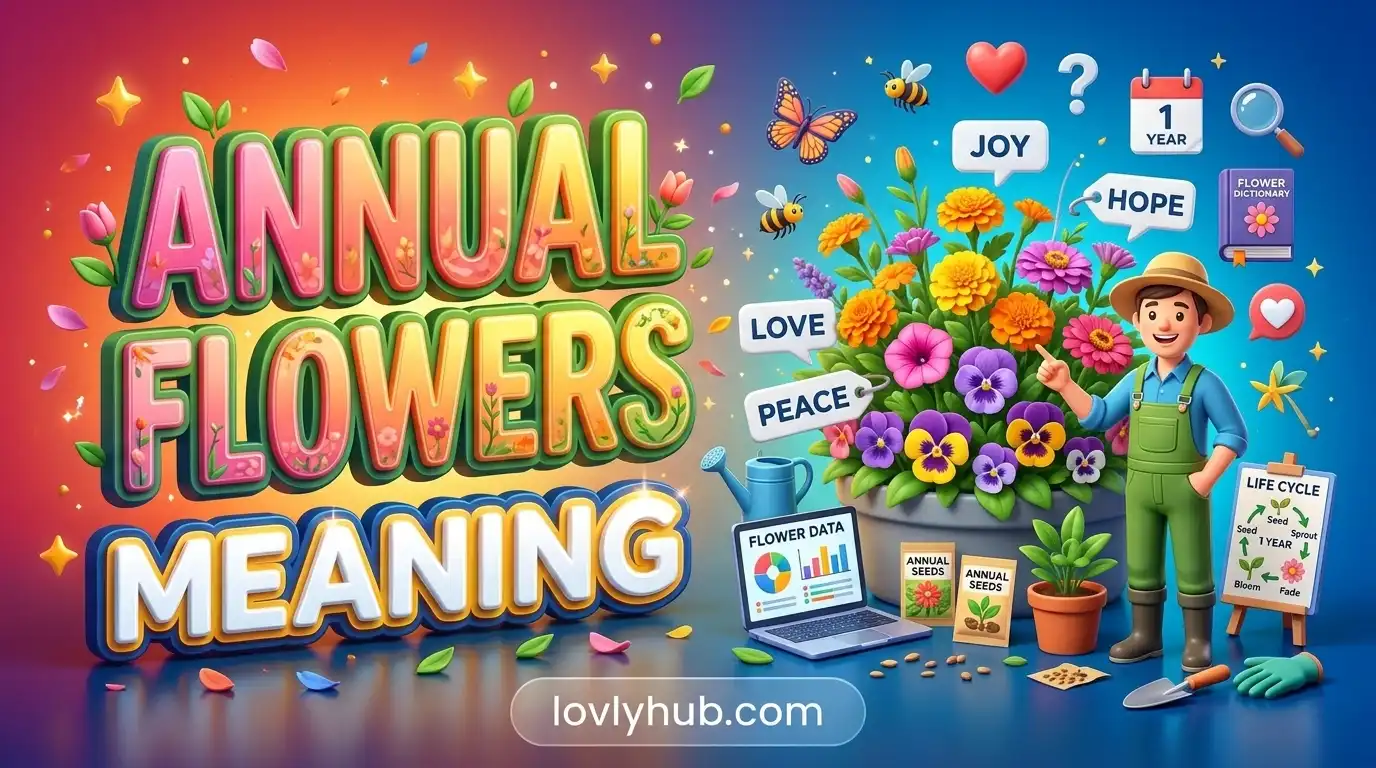
When someone searches for annual flowers meaning, they may simply want to know what makes a flower “annual.” Yet the answer is more interesting than it first appears. You might see a bright marigold in a garden, a petunia in a hanging basket, or a sunflower growing beside a fence and wonder whether the plant will return next year.
The word annual describes a plant’s natural life cycle. It does not simply mean that the flower blooms every year. That small difference causes a lot of confusion for new gardeners and anyone learning plant terminology.
Understanding the meaning of annual flowers makes garden planning much easier. It helps you know how long a plant normally lives, why some flowers need to be replanted, and how annuals differ from perennial and biennial plants.
This guide explains annual flowers meaning in simple language, explores the term in different contexts, gives real conversation examples, and covers common misunderstandings. By the end, you will be able to use the term correctly and understand exactly what it tells you about a flowering plant.
Quick Definition of “Annual Flowers Meaning”
Annual flowers are flowering plants that naturally complete their entire life cycle within one growing season or year, usually growing from seed, flowering, producing seeds, and then dying. The term can also describe plants grown as annuals in a particular climate, even when they may survive longer in warmer conditions.
In simple terms, an annual flower is usually planted, grows, blooms, produces seeds, and finishes its life cycle within a single season.
Examples include many varieties of marigolds, zinnias, petunias, cosmos, and sunflowers.
The important point is that “annual” refers mainly to the plant’s life cycle, not merely how often it flowers.
Detailed Meaning Breakdown
The clearest way to understand annual flowers is to look at what happens during their life.
An annual plant generally begins its life as a seed. Once conditions are suitable, the seed germinates. The young plant develops roots, stems, and leaves. It then reaches maturity and produces flowers.
After flowering, the plant usually produces seeds. Those seeds may become the next generation of plants. Once the original plant has completed reproduction, it naturally dies.
This entire process can happen within several months.
That is why the word annual can be misleading. It does not mean that one individual plant lives forever and blooms once every year. Instead, it means the individual plant completes its biological life cycle within roughly one growing season.
The primary meaning
The primary meaning of annual flowers is therefore:
A flowering plant that completes its complete life cycle—from seed to mature plant to seed production—within one growing season or year.
For example, imagine planting zinnia seeds in spring. The seeds sprout, the plants grow through summer, flowers appear, and seeds develop later in the season. Eventually, the original zinnia plants die.
If you plant new zinnia seeds the following year, new plants grow. The flower may appear in your garden year after year, but the individual plants are not necessarily the same ones.
A useful secondary meaning
Gardeners sometimes use “annual” in a practical rather than strictly botanical way.
A plant may technically be capable of surviving for several years in its native environment, but gardeners in a colder region may grow it as an annual because winter temperatures kill it.
This means the same plant can be treated differently depending on climate.
For example, a tender flowering plant may survive winter in a warm region but die outdoors during freezing weather in a colder region. Gardeners in the colder location may simply plant it again each spring.
Are there rare meanings?
There are no major alternative meanings of “annual flowers” in everyday gardening language.
However, the term can sometimes refer to a plant’s cultivation status rather than its strict biological classification. This distinction matters because a plant may be perennial in one climate but grown as an annual somewhere else.
So when someone says, “I grow this as an annual,” they may mean, “I do not expect this plant to survive my local winter.”
What “Annual Flowers Meaning” Means in Different Situations
The phrase can appear in gardening guides, social media posts, plant labels, conversations, and even casual messages. Its basic meaning stays the same, but the purpose can change depending on the situation.
Everyday Texting
In everyday conversation, people often use the phrase while discussing gardens, flowers, landscaping, or plant care.
Someone might text:
“I bought some annual flowers for the front garden.”
Here, the person means flowers that are expected to complete their life cycle within one season or are being grown as annuals in that location.
Another person might ask:
“Do annual flowers come back every year?”
This question is common because people often confuse annuals with perennials.
A simple answer is that individual annual plants usually do not return after completing their life cycle, although some annuals can reseed themselves.
Social Media Platforms
On Instagram, Pinterest, Facebook, TikTok, and gardening forums, “annual flowers” is often used when people share seasonal garden ideas.
A caption might say:
“Adding bright annual flowers for a summer garden.”
The phrase usually tells viewers that the plants are intended to provide seasonal color.
Social media has also made the term more visual. Gardeners often show annuals as quick ways to create colorful displays in containers, borders, balconies, and small garden spaces.
Dating & Relationships
The phrase annual flowers meaning has little direct connection to dating or romantic communication.
However, flowers themselves can have symbolic meanings in relationships. A person may give flowers to express affection, appreciation, celebration, apology, or friendship.
In that context, “annual” still describes the plant’s life cycle. It does not automatically give the flower a romantic meaning.
For example, saying:
“She grows annual flowers.”
is simply a gardening statement.
Saying:
“I bought annual flowers for our anniversary.”
uses “annual” in a different way. Here, “annual” relates to something happening every year, such as an anniversary, rather than describing the flowers themselves.
This distinction is important because annual flower and annual event are not the same use of the word.
Professional Communication
In gardening, landscaping, horticulture, and nursery businesses, the term has a specific practical meaning.
A professional might write:
“Annual flowers should be planted after the danger of frost has passed.”
Here, the term communicates information about the plant category and expected growing pattern.
Landscape professionals may also use the word when discussing seasonal displays, planting budgets, maintenance schedules, and replacement plans.
For example, an annual planting may require new plants each growing season, while established perennial plants can remain in place for several years.
Cultural or Regional Differences
The biological meaning of annual flowers is broadly consistent across English-speaking regions.
The main difference comes from climate.
A plant described as an annual in the United Kingdom may be treated differently in parts of the southern United States or other warmer regions. Weather, frost, heat, rainfall, and growing conditions can affect whether a plant survives from one year to the next.
This is why gardening advice should always consider local climate.
A plant label saying “annual” may reflect how the plant behaves under expected local growing conditions rather than claiming that it can never survive for more than one year anywhere on Earth.
Psychological & Tone Analysis
Why do people care about whether a flower is annual?
One reason is expectation.
Gardeners want to know what will happen after planting. If a plant is annual, the gardener can expect a relatively short life cycle and plan accordingly.
The term also signals seasonality.
Annual flowers are often associated with temporary displays, strong seasonal color, quick garden changes, and flexible planting designs. This can make them appealing to people who enjoy changing their garden each year.
There is also an emotional layer.
Annual flowers can represent the idea that something beautiful does not have to last forever to be valuable. A garden filled with seasonal flowers can provide color for a few months, creating a visual experience that changes with time.
From a communication perspective, the word “annual” is neutral and practical. It does not automatically suggest beauty, romance, permanence, or short-lived emotions.
The emotional meaning usually comes from the flower, occasion, color, or situation, not from the word “annual” itself.
15 Real Conversation Examples
1. “Are marigolds annual flowers?”
This is a classification question. The speaker wants to know whether marigolds normally complete their life cycle within one growing season.
2. “Do annual flowers come back next spring?”
This shows a common misunderstanding. Annual plants generally do not survive as the same mature plants, although some may reseed naturally.
3. “I planted annual flowers around the patio.”
The speaker is describing a seasonal garden design using plants expected to provide color for part of the year.
4. “Which annual flowers grow well in containers?”
Here, “annual” identifies the type of plant, while the rest of the question focuses on growing conditions.
5. “These annuals gave my garden so much color.”
“Annuals” is a shortened gardening term for annual plants or annual flowers.
6. “Should I remove my annual flowers after they die?”
This is a practical gardening question about end-of-season cleanup.
7. “I buy annual flowers every spring.”
The speaker understands that annual plants may need to be purchased or grown again each season.
8. “Are annual flowers easier than perennials?”
This is a comparison of plant categories. The answer depends on the particular plants and growing conditions.
9. “The nursery has a whole section for annual flowers.”
The phrase is being used as a retail category.
10. “I want annual flowers for a colorful summer garden.”
The speaker is choosing plants mainly for seasonal visual impact.
11. “Can annual flowers reseed themselves?”
This question recognizes that an annual plant can die while leaving seeds behind that may grow later.
12. “This plant is technically perennial, but we grow it as an annual.”
This example demonstrates the importance of climate. A plant may survive for years under suitable conditions but be treated as an annual elsewhere.
13. “What is the difference between annual and perennial flowers?”
This is one of the most useful questions for beginners because it compares two major plant life-cycle categories.
14. “I planted annual flowers because I like changing my garden every year.”
Here, annual plants are connected to gardening flexibility and seasonal design.
15. “The annual flowers are finished for the season.”
The speaker means the plants have completed or are nearing the end of their seasonal display and life cycle.
When “Annual Flowers” Can Be Misunderstood
The biggest confusion comes from the word annual.
Many people naturally interpret “annual” as “something that happens once every year.” That meaning is correct in phrases such as “annual meeting” or “annual celebration.”
But “annual flower” describes a plant’s life cycle.
An annual flower does not necessarily bloom once per year forever. Instead, the individual plant typically completes its life cycle within one growing season.
Context confusion
Consider these two sentences:
“We have an annual garden.”
“I attend an annual gardening show.”
The first could describe a garden made with annual plants. The second means the gardening show occurs every year.
The same word has related but different meanings.
Generational gaps
Older gardening traditions and newer social media gardening content may use plant terminology differently.
A beginner might hear “annual” and assume it means “comes back every year.” A more experienced gardener is more likely to understand that the term refers to the plant’s life cycle.
Clear explanations prevent this misunderstanding.
Platform differences
Social media captions often shorten terminology.
“Planting annuals!”
may be perfectly clear to gardeners, while someone new to gardening may not know that “annuals” means annual plants.
Search engines, plant labels, nursery catalogs, and gardening communities may also use slightly different wording for the same basic concept.
Similar Words, Symbols, or Abbreviations
Here are 10 related terms that help explain the meaning of annual flowers:
- Annual — A plant that completes its life cycle within one growing season or year.
- Perennial — A plant that normally lives for multiple years and can continue growing across seasons.
- Biennial — A plant that normally completes its life cycle over two growing seasons.
- Annuals — A common shortened term for annual plants or annual flowers.
- Seasonal flowers — Flowers commonly associated with a particular season, although the term does not always mean the plant is biologically annual.
- Tender annual — A plant grown as an annual because it cannot tolerate local cold conditions.
- Hardy annual — An annual plant that can tolerate relatively cool conditions.
- Self-seeding — A process where a plant drops seeds that may grow into new plants naturally.
- Growing season — The part of the year when environmental conditions allow plants to grow successfully.
- Perennialization — A situation where a plant expected to be grown as an annual survives and behaves more like a perennial under suitable conditions.
Knowing these terms makes plant labels and gardening articles much easier to understand.
When Not to Use “Annual Flowers”
The phrase is useful, but it should not be used as a replacement for every discussion about flowers.
Professional risks
In professional gardening or landscaping, vague wording can cause confusion.
If a client asks whether a plant will return next year, simply saying “It is an annual” may not provide enough information. Climate, frost, reseeding, and local growing conditions can all matter.
A clearer explanation might state whether the plant is expected to survive winter in that specific location.
Cultural risks
There are few serious cultural risks associated with the phrase itself. However, gardening traditions vary across regions.
Avoid presenting one region’s growing experience as a universal rule.
A plant that behaves as an annual in a cold climate may survive for years in a warmer climate.
Tone risks
The phrase is generally neutral and informative.
However, avoid using “annual” to imply that a flower is automatically temporary, low-quality, or less valuable. Annual plants can be highly attractive and useful in gardens.
Their shorter life cycle is simply a biological characteristic.
Expert Tips for Using “Annual Flowers” Correctly
1. Focus on the life cycle
Remember that annual refers primarily to how long the individual plant takes to complete its life cycle.
2. Do not confuse annual with yearly blooming
A flower does not become an annual simply because it blooms every year.
3. Consider the climate
Always check local growing conditions. A plant’s behavior can change dramatically between climates.
4. Learn the annual-perennial difference
This basic distinction makes many gardening conversations easier to understand.
5. Check whether the plant self-seeds
An annual plant may disappear while leaving seeds that produce new plants later.
6. Read plant labels carefully
Nurseries may use terms such as annual, tender perennial, hardy annual, or perennial depending on the plant and growing region.
7. Use “annuals” as a shorthand
Once the context is clear, “annuals” is a natural and common way to refer to annual flowers.
8. Explain the term for beginners
If you are writing for a general audience, say that annual flowers usually complete their life cycle in one season. This prevents the most common misunderstanding.
Frequently Asked Questions
What is the meaning of annual flowers?
Annual flowers are flowering plants that normally complete their entire life cycle within one growing season or year. They grow, flower, produce seeds, and then die.
Do annual flowers come back every year?
Usually, the same annual plant does not come back after completing its life cycle. However, some annuals can drop seeds that grow into new plants the following season.
What is the difference between annual and perennial flowers?
Annual flowers usually complete their life cycle within one season. Perennial flowers normally live for multiple years and can grow again during future seasons.
Why are flowers called annuals?
They are called annuals because their natural life cycle is completed within about one year or one growing season. The word describes the plant’s biological cycle.
Are annual flowers good for gardens?
Yes. Annual flowers can provide strong seasonal color and are useful for containers, borders, beds, balconies, and temporary garden displays.
Can an annual flower become a perennial?
In some cases, a plant commonly grown as an annual can survive for several years if it receives suitable temperatures and growing conditions. Whether this happens depends on the species and climate.
What are common examples of annual flowers?
Common examples include marigolds, zinnias, cosmos, petunias, and many types of sunflowers. Exact growing behavior can vary by species and climate.
**What does “annuals” mean in gardening?
“Annuals” is simply the plural form used by gardeners to describe annual plants. It is a common shorthand when the context is already clear.
Final Summary & Smart Usage Advice
The meaning of annual flowers is simple once you separate the gardening definition from the everyday meaning of the word “annual.”
An annual flower is a plant that normally completes its entire life cycle within one growing season or year. It grows from seed, develops into a mature plant, flowers, produces seeds, and eventually dies.
The most important detail is that annual does not mean a flower returns every year. In fact, the original plant usually does not survive into another growing season. New plants may appear through fresh seeds or new planting.
Annual flowers are popular because they can provide fast, vivid, seasonal color. They work well in garden beds, containers, borders, balconies, and changing landscape designs.
The term can also depend on climate. A plant that behaves like an annual in one region may survive as a perennial in another. That is why local weather and growing conditions matter when interpreting plant labels.
If you remember just one idea, make it this:
Annual describes the plant’s life cycle, not simply how often its flowers appear.
Once that distinction is clear, terms such as annual, perennial, biennial, seasonal, and self-seeding become much easier to understand. Whether you are reading a nursery label, planning a garden, writing a gardening post, or simply answering a question about flowers, you can now use annual flowers meaning accurately and confidently.

Emma Carter is a dedicated content writer who shares insightful, informative, and reader-friendly articles to help people learn something new every day.